Understanding
Why pistachios are open, green, pink or sometimes red
You can read a pistachio like a label. Its split shell, the colour of its kernel, a stain on one side: every detail tells you when it was picked and how it was handled.
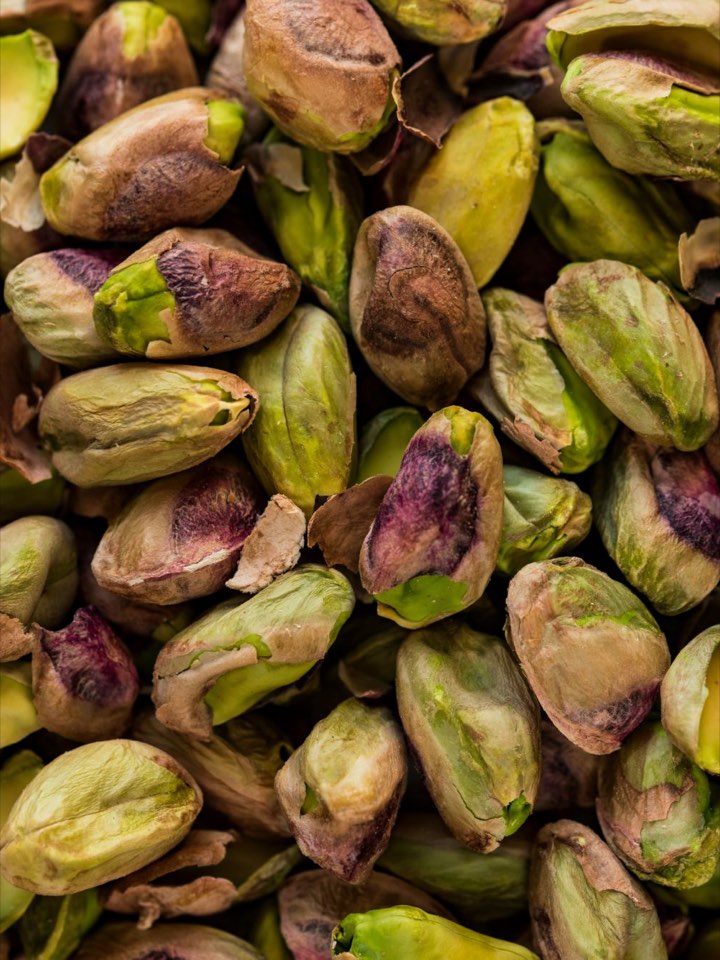
No other nut raises so many questions about the way it looks. Nobody asks why a hazelnut is round. But a pistachio that is half open, green inside, sometimes pink, once red: that makes people curious, and rightly so, because each of these colours has an explanation.
Why are pistachios open?
Because they open by themselves, on the tree, before the harvest. The shell hardens in July, while it is still almost empty. The kernel then grows inside and eventually runs out of room: in August, it bursts the shell along its seam.
So it is neither drying nor roasting that opens a pistachio. It is a trait growers have selected for over the centuries, and it varies from one variety to another: in Californian trials, Kerman gives about 70% split shells, Golden Hills 87%. Watering plays a part too: an irrigated orchard gives more open shells.
A little-known detail: the US standard has a category for “artificially opened” pistachios. Some shells that stayed closed are split by machine before being sold.
Can you eat pistachios that won’t open?
Yes, they are perfectly safe. But a closed shell almost always means a kernel that had not finished growing: it is smaller, less tasty, and its texture is less crisp. In the industry, these pistachios are sorted out, cracked and sold as kernels.
Two or three closed pistachios in a bag are normal. A bag with lots of them was poorly sorted. Either way, don’t crack them with your teeth: a nutcracker, or half an empty shell slipped into the gap of a pistachio that is barely open, does a better job.
Why are pistachio kernels green?
Because of chlorophyll, the pigment in leaves. The pistachio is one of the very few nuts that keeps some in its kernel. Add to that yellow pigments, lutein and zeaxanthin, which pull the colour towards a yellowish green.
How green it is depends on three things.
- When it was harvested. The earlier a pistachio is picked, the greener it is. In France, some growers harvest green kernels a month before full ripeness, when the kernel fills 80% of the shell: these go to pastry chefs and ice-cream makers, who pay for the colour.
- The variety and origin. Bronte pistachios, from Sicily, are known for their deep green; the big pistachios sold for nibbling with drinks are more yellow.
- Roasting. It makes the kernel paler: a roasted pistachio contains 2.5 times less lutein and zeaxanthin than a raw one.
So a slightly dull yellow-green pistachio is not a poor one. It was simply picked ripe, to be eaten as it is.
Why is pistachio ice cream so green?
Because it is almost always coloured. An ice cream or a cream made only from pistachios comes out khaki, or even beige. The bright green of factory-made products comes from colourings: on the labels of pistachio spreads you very often find E141, a chlorophyll derivative, together with E100, curcumin, which is yellow. It is not harmful. It is a clue: the brighter the green, the less it owes to the pistachio.
Why are some pistachios pink or purple?
There are two different pinks, both natural.
- On the tree, the fleshy outer skin of the fruit, the hull, turns from green to pink as the pistachio ripens. That is the signal to harvest. It is removed straight afterwards, and you never see it.
- In the bag, it is the thin skin covering the kernel that is pink, violet or purple. It owes its colour to anthocyanins, the pigments in black grapes and blueberries. It is edible.
Blanched pistachios are kernels with this skin removed, leaving only the green.
Why were pistachios red?
Because they were dyed. Until the 1980s, a large share of the pistachios sold in the United States, imported from the Middle East, had bright red shells and left your fingers the same colour.
The most common explanation has to do with the harvest. A pistachio must be freed from its hull within 24 hours, or the tannins in the hull stain the shell brown. Pistachios picked by hand and hulled late therefore arrived mottled, and the dye hid the marks. Another version credits the idea to a Brooklyn merchant who supposedly wanted to set his pistachios apart from his competitors’.
The dye disappeared with the rise of the Californian orchards, where pistachios are hulled by machine within hours of harvest: a clean shell has nothing to hide. Opinions still differ on what part the US embargo on Iranian goods played in its disappearance.
The lesson still holds. A pale shell with no stains means quick hulling, and so careful work. We describe those 24 hours in the article on the pistachio harvest.
What do sizes like 21/25 mean?
On bulk sacks of pistachios, two numbers give the size: the number of in-shell pistachios in one ounce, or 28 grams. The lower the number, the bigger the pistachio.
| Grade | Pistachios per ounce |
|---|---|
| Colossal | under 18 |
| Extra Large | 18 to 20 |
| Large | 21 to 25 |
| Medium | 26 to 30 |
| Small | over 30 |
Size tells you nothing about flavour. The small green pistachios from Sicily or Turkey are more sought after for pastry than the big ones sold for nibbling.
How can you tell a good pistachio?
- The shell is pale, with no brown stains, and clearly split.
- The kernel fills the shell well.
- The colour ranges from green to yellow, under a purple skin. Neither grey nor brown.
- When you bite it, it crunches. A soft pistachio has taken on moisture.
- It smells fresh. A smell of paint or old cardboard means a rancid pistachio: see the article on storing pistachios.
- The label states the origin, and ideally the harvest year.
Frequently asked questions
Do pistachios open when they are roasted?
No. They open on the tree, in August, when the growing kernel bursts the shell. Roasting only dries them and brings out their flavour.
Can you eat the purple skin on pistachios?
Yes. It is a very thin skin, coloured by anthocyanins. It is only removed to make blanched pistachios, an even green, used in pastry.
Why are pistachios salted?
Out of apéritif habit: most pistachios in the shops are roasted then salted, at about 1.5 g of salt per 100 g. You can also find plain in-shell pistachios, neither roasted nor salted, which taste milder and greener.
Is a pistachio a fruit or a nut?
Both, depending on how you look at it. To a botanist, the fruit of the pistachio tree is a drupe, like the peach, and we eat its seed. To a cook, and under allergen regulations, it is a tree nut. It is not a legume like the peanut: the pistachio tree is a cousin of the cashew tree.
Sources
- Scientific review of the pistachio: production, pigments, nutrients, health, Mandalari et al., Plants journal, 2022.
- Pistachio: postharvest fact sheet, UC Davis Postharvest Research and Extension Center, 2025.
- United States standards for grades of pistachios, Code of Federal Regulations, Title 7, Part 51.
- The story of red pistachios in the United States, FreshPlaza, 26 January 2024.
- Pistachio spreads: ingredient lists, Open Food Facts, French site.
- Dry-roasted pistachios, without salt: nutrient composition, USDA FoodData Central.
- Pistachio Cultivars in California, C. Kallsen, UC Cooperative Extension.
- Good Agricultural Practices for Pistachio Growers, University of California and California Pistachio Research Board, 2009.
- La pistache récoltée en amandon vert, Pleinchamp, 13 October 2026, in French.