Growing
Growing pistachio trees in France: the climate, soil and water they need
The pistachio tree asks for three things few places offer together: a proper winter, a long dry summer and soil that does not hold water. Before you order any trees, these are the thresholds to check on your land.
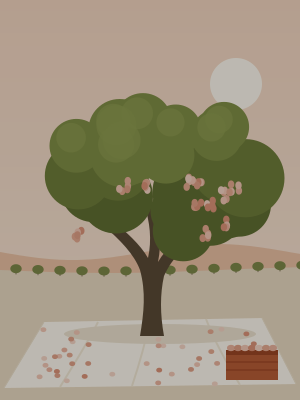
You read everywhere that the pistachio tree “needs nothing”: no water, no care, just stones. That is half true, and it is the false half that costs money. The tree will survive almost anywhere in the south of France. Getting it to produce full, open nuts year after year is another matter: winter, summer and soil all have to be right.
We planted in Brignoles in 2019. These are the criteria we would look at today, in the order in which they rule a plot out.
How much winter cold does a pistachio tree need?
More than you would expect from a tree that comes from the steppes. A pistachio tree only flowers properly once it has built up enough chill hours over the winter, counted below 7 °C. Below that threshold, flowering drags on, male and female trees no longer flower at the same time, and the harvest suffers.
The figures vary from one research station to the next, which shows they are not set in stone.
| Variety | Castilla-La Mancha | Other references |
|---|---|---|
| Kerman | 1,100 h | at least 1,000 h (Aragon), about 700 h (California) |
| Sirora | 900 h | at least 700 h (Aragon) |
| Larnaka | 800 h | at least 700 h (Aragon) |
| Aegina, Avdat, Mateur | 800 h | not stated |
| Peters (male) | not stated | at least 900 h (California) |
In France, the Chambre d’agriculture de Vaucluse (the Vaucluse chamber of agriculture) and INRAE, the French national research institute for agriculture, food and the environment, give a range of 400 to 900 hours depending on the variety, while pointing out that these values are old and need revisiting. Spanish researchers, for their part, advise against growing pistachios below 700 hours.
A concrete benchmark: the Pyrénées-Orientales received between 729 and 1,036 chill hours a year from 2015 to 2022. That is enough for the less demanding varieties, and only just enough for Kerman in mild winters. On the Mediterranean coast, then, the problem is more likely to be too little cold than too much.
Are pistachio trees damaged by frost?
The dormant tree, no: the Pistache en Provence association gives a range of −15 °C to +45 °C. The flower, yes. In Provence the pistachio tree flowers in April, from early April to early May depending on the variety, and an open flower cannot stand more than half an hour at −2.5 °C. This is the number one risk, the one that leads the farming press to describe the species as frost-sensitive.
Three practical consequences:
- avoid low ground and hollows, where cold air collects on clear April nights;
- be wary of early-flowering varieties where late frosts are common;
- check how well the rootstock stands the cold: Pistacia integerrima is not recommended once winter lows drop below −8 °C.
What kind of summer does it need?
Long, hot and dry. Spanish researchers measure it in heat units from April to September: around 3,600 for late varieties such as Kerman, 3,200 for early ones. It is this heat, more than the cold, that limits the crop further north and at altitude.
Air humidity matters as much as temperature. Pollen travels on the wind, and April rain washes it out. In summer, humid air, above 40 to 50% average relative humidity from June to August, encourages septoria and alternaria, the two leaf diseases most common in Provence. In September, rain stains the shells and raises the risk of mould.
The benchmarks given in Castilla-La Mancha: less than 50 to 60 mm of rain in April, less than 20 to 30 mm in September. The Pistache en Provence association also advises avoiding plots prone to heavy dew. The mistral, which dries everything out, is an ally here.
What soil does a pistachio tree need?
Soil that drains quickly after rain. The pistachio tree copes with limestone, stones and poor ground. What it cannot cope with is roots sitting in water: root asphyxia is the first plot defect that advisers mention.
- Texture. Light soils, with less than 20% clay according to the Chambre d’agriculture de Vaucluse. Spanish references rate the results as poor above 30%.
- pH. Neutral to alkaline, 7 to 8, tolerated up to 8.5. Acid soils should be ruled out.
- Drainage. No standing water, even briefly. On heavier soil, plant on mounds.
- Previous crop. No pistachios after melons or tomatoes, which keep verticillium wilt going: a soil-borne fungus for which there is no treatment.
- Soil profile. Spanish advisers recommend analysing the soil down to 1.5 m. Dig before you plant, not after.
The soil also determines the rootstock: UCB1 tolerates verticillium wilt, terebinth does not. We go through that choice in the article on grafting and rootstocks.
Do pistachio trees need irrigation?
You can do without it to keep the tree alive, not to make a living from it. That is the nuance the enthusiastic articles leave out.
| Management | Water applied per year | Observed yield |
|---|---|---|
| Rain-fed (350 to 400 mm of rain) | none | about 1,000 kg/ha, from the 8th year after grafting |
| Supplementary irrigation | 1,500 m³/ha | about 1,500 kg/ha |
| Full irrigation | 3,000 m³/ha | 2,000 to 2,500 kg/ha |
In France, the growers’ union France Pistache argues for about 1,500 m³ per hectare per year, mainly to even out alternate bearing between good and bad years. That is 150 mm, a quarter of the irrigation benchmark for a peach orchard in Occitanie, and a seventh of what a Californian pistachio orchard receives.
Either way, irrigation is essential for the first three years, while the roots go down. Only then does rain-fed growing become possible: it is the choice made for half of Spain’s pistachio orchards, on deep soils and at lower planting density.
Where can you grow pistachios in France?
The Chambre d’agriculture de Vaucluse and INRAE consider the Vaucluse, the Bouches-du-Rhône, the south of the Alpes-de-Haute-Provence and the Var to be suitable. To these can be added, in Occitanie, the Aude, the Gard, the Hérault and the Pyrénées-Orientales, then the south of the Drôme and the Ardèche, and Corsica. The farming press sums it up as an arc from Carcassonne to Carpentras.
The northern limit is not known. Current plantings barely go beyond the 45th parallel, which runs through Valence. Further north, two things are missing at once: enough summer heat to ripen the nuts, and dry enough air. For an ornamental tree, the question is a different one: we answer it in the article on the pistachio tree in the garden.
The decision checklist, criterion by criterion
| Criterion | Green light | Red light |
|---|---|---|
| Winter cold | over 800 h below 7 °C, 1,000 h for Kerman | under 700 h |
| April frost | rare, plot on a slope | frequent, plot on low ground |
| Summer | long, dry, windy | humid, regular rain in September |
| Soil | free-draining, pH 7 to 8.5 | waterlogged in winter, acid, over 30% clay |
| Water | 1,500 m³/ha available | no access to water for the first three years |
| Previous crop | nothing susceptible to verticillium wilt | melon, tomato |
A single red light does not always rule a plot out: a mound can fix heavy soil, an early variety a short summer. Two red lights do. Once the plot passes the checklist, you still have to decide on spacing and put figures on the project: that is the subject of the article on planting, costs and grants.
Frequently asked questions
Can pistachio trees grow outside Provence?
Yes. They are being planted in the Aude, the Gard, the Hérault, the Pyrénées-Orientales, the south of the Drôme and the Ardèche, and in Corsica. North of the 45th parallel there is no record of a producing orchard: summers are no longer hot enough.
Do pistachio trees need a lot of water?
No, compared with other fruit trees: French growers aim for about 1,500 m³ per hectare per year. But irrigation is essential for the first three years, and an orchard grown without water produces markedly less.
What altitude can pistachio trees be grown at?
Spanish trials range from under 300 m to over 900 m above sea level. In France, no limit has been published. What to check is not the altitude itself but the heat built up from April to September and the risk of frost in April.
Can you grow pistachios organically?
Yes, and many growers do: in 2021, about 70% of the hundred or so hectares planted at the time were farmed organically. However, no plant protection product is approved specifically for the crop; the few possible uses rely on temporary exemptions.
Can you replace a vineyard with pistachio trees?
Yes, if the soil drains well, and some winegrowers in the south of France are already diversifying this way. Bear in mind that the trees produce nothing for five to seven years: work out the figures before you pull up the vines, not after.
Sources
- Café Agro « Fruits à coque », Chambre d’agriculture de Vaucluse and INRAE, 2021, in French.
- Le pistachier, Pistache en Provence association, in French.
- Pistachio growing practices: a student report, Institut Agro Montpellier for SICA Centrex, 2024, in French.
- Overview of pistachio growing: climate, soil, rootstocks, varieties, IRIAF El Chaparrillo (Castilla-La Mancha), Agricultura magazine, 2010, in Spanish.
- El pistacho (1): requirements, soil, water and year-by-year yields, J. F. Couceiro, IRIAF El Chaparrillo, in Spanish.
- PISTARA project: adapting the pistachio tree to Aragon, Government of Aragon, in Spanish.
- Winter Chilling of Pistachio, E. Fichtner, UC Cooperative Extension, 2022.
- Pistachio Cultivars in California, C. Kallsen, UC Cooperative Extension.
- La pistache récoltée en amandon vert, Pleinchamp, 13 October 2026, in French.
- La pistache, une jeune filière pleine de promesses, Terre-net, 9 June 2025, in French.