Growing
Grafting pistachio trees: terebinth or UCB1, when and how
Grafting is the trickiest step in growing pistachios, and a common reason young orchards fail. The choice of rootstock, meanwhile, is made once and for all.
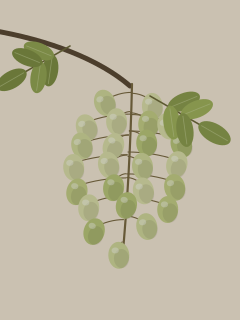
Sow a pistachio nut and you will get a pistachio tree, but not the variety of the mother tree, and not necessarily a female. As with apple trees, the only way to plant Kerman is to graft Kerman. What sets the pistachio apart is that it is grafted onto a different species from its own, and that the graft does not take easily.
Why are pistachio trees grafted?
For three reasons. Grafting reproduces the exact variety and sex of the chosen tree. It brings the first crop forward by two to three years, according to the Pistache en Provence association. Above all, it gives the tree roots that are not its own: the true pistachio, on its own roots, lacks vigour and is susceptible to soil-borne diseases. So it borrows the roots of a tougher cousin.
Which rootstock should you choose for a pistachio tree?
There are five candidates, only two of which really matter in France.
| Rootstock | Strengths | Limitations |
|---|---|---|
| Terebinth (Pistacia terebinthus) | The most cold-hardy and the cheapest. The most widely used in Spain. | Susceptible to verticillium wilt. Uneven seedlings. |
| UCB1 (atlantica × integerrima hybrid) | Vigorous. Tolerant of verticillium wilt. | The most expensive. Susceptible to nematodes. Moderate cold hardiness. |
| Pistacia atlantica | More vigorous than terebinth. | Highly susceptible to verticillium wilt and phytophthora. |
| Pistacia integerrima | Very vigorous. Tolerant of verticillium wilt. | The most sensitive to cold, not recommended below −8 °C. Needs deep, irrigated soil. |
| Pistacia vera (seedling) | Worth considering for rain-fed orchards. | Lacks vigour. Susceptible to soil-borne diseases. The hardest to graft. |
In Provence, the first orchards were planted on UCB1 and terebinth, and a 2024 survey of growers shows that nine out of ten chose one or the other. There is no single official recommendation: the Chambre d’agriculture de Vaucluse (the Vaucluse chamber of agriculture) and INRAE, the French national research institute for agriculture, food and the environment, still regard the choice as a difficult one.
A simple rule of thumb still emerges.
- Lean towards UCB1 if the plot has grown crops susceptible to verticillium wilt, such as melon or tomato, and if the orchard will be irrigated.
- Lean towards terebinth if the plot is cold, if the orchard will be rain-fed, or if the budget is tight.
One Spanish finding is worth knowing: rain-fed and on shallow soil, the most vigorous rootstocks turn out to be the least productive. Vigour is not always a virtue.
Terebinth has a sentimental advantage: it grows wild in the garrigue scrubland of Provence, and pistachio trees were already being grafted onto it two centuries ago. To tell it apart, see our article on the true pistachio, the mastic tree and the terebinth.
When should you graft a pistachio tree?
Mostly in summer, which surprises fruit growers used to grafting in spring.
| Technique | Timing | Good to know |
|---|---|---|
| T-budding | June to September | When the bark lifts easily. In very hot areas, late August or early September, as a dormant bud. |
| Chip budding | May and June | Using budwood kept in cold storage. Best results in the nursery. |
| Whip grafting | March and April | A nursery technique. |
Three conditions matter more than the date:
- diameter: the rootstock must measure at least 10 mm at 30 cm above the ground;
- sap flow: the bark must lift easily, a sign that the tree is in full growth;
- temperature: the ideal is between 20 and 32 °C, and success drops sharply above 35 °C.
That temperature window explains many failures in the height of the Provençal summer. It also explains the timetable: half the rootstocks are big enough to graft after one summer in the ground, and all of them after two.
How is T-budding done?
- Cut a current-season shoot from a tree of the variety you want, and strip off its leaves, leaving a stub of leaf stalk.
- Make a T-shaped cut in the bark of the rootstock, about thirty centimetres above the ground.
- Slice a shield of bark carrying a bud from the shoot, and slide it under the bark of the rootstock.
- Tie it in, leaving the bud exposed.
- Two to three weeks later, check whether it has taken: the bud stays green, and the stub of leaf stalk drops off when you touch it.
- Cut the rootstock back above the graft so the sap goes to the new shoot.
The technique can be learned in a morning. Choosing the right day takes years: enough sap, not too much heat, fresh budwood.
What success rate can you expect?
The Spanish figures, published by the El Chaparrillo research station, are the most candid we know of.
| Situation | Success rate |
|---|---|
| Controlled conditions, in the nursery | over 90% |
| Open field, Lleida area | over 70% |
| Open field, Toledo area | at least 50% |
| Open field, Ciudad Real area | 5 to 10% |
| Open-field average | 37% a year, over 85% cumulative over four years |
In other words, grafting in the field means accepting that you will regraft the failures for three or four summers, and then manage an orchard of mixed ages. That is what led the first Provençal growers to bring in grafters from Spain, and then the industry to turn to nursery-grafted trees.
Should you buy trees that are already grafted?
For a commercial orchard, yes. The growers’ union France Pistache acknowledges that the early years of the revival were marked by badly grafted trees and by tree losses, and the regional planting grant now requires trees from a partner nursery.
On delivery, three checks are better than a complaint later:
- the graft union is clean, with no split callus or oozing;
- the variety and the rootstock are on the label, because the rootstock will decide how well the tree does in your soil;
- the males are labelled one by one. A male planted in place of a female only shows itself at the first flowering, years later.
Frequently asked questions
Can you graft a pistachio onto a wild terebinth?
Yes. Terebinth is the traditional rootstock for pistachio in Provence, and it is still the most widely used in Spain. The stock needs to be at least 10 mm in diameter at 30 cm above the ground, and you have to accept an uncertain success rate in the open field.
Can you graft a pistachio onto a mastic tree?
None of the technical references we consulted lists the mastic tree as a rootstock. The species used are terebinth, Pistacia atlantica, Pistacia integerrima and their hybrid UCB1.
What is UCB1 rootstock?
It is a hybrid of Pistacia atlantica and Pistacia integerrima, developed in California. It is vigorous and tolerates verticillium wilt, but it costs more than terebinth and is less cold-hardy.
How long after grafting does a pistachio tree produce nuts?
Spanish references record the first nuts around the fourth year after grafting, at a few hundred grams per tree. A harvest worth the name comes around the eighth year.
Why is grafting pistachio trees so difficult?
Because the window is narrow: you need bark that lifts easily, fresh budwood and a temperature between 20 and 32 °C. CIHEAM researchers describe propagating pistachio as delicate at every stage, from sowing the rootstock to transplanting.
Sources
- La operación de injerto: grafting the pistachio tree, El Chaparrillo, Fruticultura magazine, 2004, in Spanish.
- Propagation and grafting of the pistachio tree, Aletà et al., CIHEAM, Options Méditerranéennes, 1997.
- Overview of pistachio growing: climate, soil, rootstocks, varieties, IRIAF El Chaparrillo (Castilla-La Mancha), Agricultura magazine, 2010, in Spanish.
- El pistacho (1): requirements, soil, water and year-by-year yields, J. F. Couceiro, IRIAF El Chaparrillo, in Spanish.
- Le pistachier, Pistache en Provence association, in French.
- Pistachio growing practices: a student report, Institut Agro Montpellier for SICA Centrex, 2024, in French.
- Café Agro « Fruits à coque », Chambre d’agriculture de Vaucluse and INRAE, 2021, in French.
- La pistache, une jeune filière pleine de promesses, Terre-net, 9 June 2025, in French.
- Le pistachier en Provence, étude ethnobotanique, Magali Amir, Courrier scientifique of the Luberon Regional Nature Park, no. 16, 2019–2020, in French.