Growing
Male and female pistachio trees: telling them apart, choosing varieties
A single pistachio tree will never give you pistachios. You need female trees to bear the nuts, males for the pollen, and both flowering in the same week.
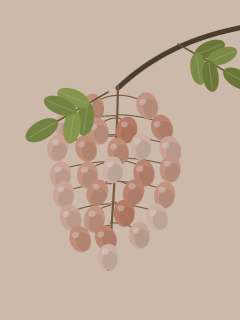
It is the thing that most surprises people new to the crop: pistachio trees come as males and females, and an orchard with only females would produce nothing. So varieties are always chosen in pairs.
Is a pistachio tree male or female?
One or the other, never both. Botanists call the species dioecious: the male flowers, which carry the pollen, and the female flowers, which will become pistachios, grow on different trees. The pollen passes from one to the other on the wind. Bees play no part, since the flowers have neither petals nor nectar to attract them.
In practice, this means that roughly one tree in nine in an orchard will never bear a single nut. That is the price of the harvest from the other eight.
How can you tell a male pistachio tree from a female?
At flowering, and only then.
- The male carries dense, stubby clusters laden with stamens. Shake a branch in dry weather and a cloud of yellow pollen drifts off.
- The female carries looser, longer clusters. Each flower is reduced to a pistil, with no stamens or pollen. A few weeks later, the nuts start to swell.
The rest of the year, there is no reliable way to tell them apart: not the leaves, not the bark, not the shape of the tree. So you have to rely on the nursery label and on a planting plan kept up to date. A labelling mistake only comes to light at the first flowering, several years after planting.
How many male pistachio trees do you need?
| Reference | Proportion of males |
|---|---|
| Provence, orchards under 5 ha | 1 male for every 8 females |
| Chambre d’agriculture de Vaucluse and INRAE | 1 male for every 10 females |
| Spain | 11%, one male surrounded by 8 females |
| California | 1 male for every 24 females, or 4 to 11% depending on the orchard |
| Home garden | 1 male for at most 5 females, no more than 10 to 15 m away |
The smaller and more sheltered the plot, the more males you need: the cloud of pollen over a large Californian orchard does not exist on a hectare surrounded by hedges. Where they go matters too. They are placed according to the prevailing wind, and trained a little taller than the females. The planting layout is in the article on orchard spacing and costs.
Why do the male and female have to flower together?
Because the window is short. Full bloom on a pistachio tree lasts seven to fifteen days, and a female flower does not wait. Yet varieties do not all flower on the same date: in Castilla-La Mancha, the earliest open at the end of March and the latest in mid-April. A late male next to an early female turns up after the event.
So the Spanish research station at El Chaparrillo has classified the males by flowering time.
| Female variety | Flowering | Matching males |
|---|---|---|
| Kerman | Late | Peters, Egino, 02-18 |
| Larnaka | Early | C-Especial, Askar, Nazar |
| Sirora | Not stated | C-Especial and Peters |
How well the flowering periods overlap varies from year to year, and a winter that is too mild throws it out: without enough cold, males and females no longer start together. That is why trials in Aragon advise planting two male varieties rather than one, one early and one late. It costs nothing extra, since the number of males stays the same, and the insurance is real.
Which pistachio varieties should you plant in France?
| Variety | Origin | Chill | What we know |
|---|---|---|---|
| Kerman | California | 1,000 to 1,100 h | Large nut, the benchmark for apéritif pistachios. Late. In California, 70% split shells and 10% empty nuts. |
| Sirora | Australia | 700 to 900 h | Needs less cold and less heat than Kerman. |
| Larnaka | Cyprus | 700 to 800 h | Early, few empty nuts. Planted in Provence for processing. |
| Aegina | Greece | 800 h | Planted in Provence for processing. |
| Pontikis | Greece | not published | Planted in Provence, particularly in the Luberon. |
| Napoletana | Sicily | not published | Mid-season flowering. Many closed shells in Spain. |
| Golden Hills | California | not assessed | Flowers five days before Kerman. 87% split shells, 4% empty nuts. |
In Provence, the industry steers Kerman towards apéritif pistachios, sold in the shell, and Aegina or Larnaka towards processing. Seven varieties are offered by the nurseries that partner with the growers’ union.
It needs saying plainly: none of these varieties has twenty years of track record in France. The trial orchards at La Pugère, in Mallemort, and La Thomassine, in Manosque, are young, and the chill figures come from Spain or California. Choosing a variety today is still an educated bet.
To hedge that bet:
- count the chill hours in your area before choosing Kerman, the most demanding variety;
- plant at least two female varieties, so you are not staking everything on a single flowering date;
- ask the nursery, in writing, which males it pairs with each female.
Frequently asked questions
Is there a self-pollinating pistachio tree?
No, no cultivated variety pollinates itself. Trees sold as “self-fertile” are usually trees carrying two grafts, one male and one female: get the seller to confirm this before you buy.
Do male pistachio trees produce nuts?
Never. They only produce pollen. Yet they are essential: without them, the flowers on the female trees are not fertilised and the shells stay empty.
How far apart should male and female pistachio trees be?
In an orchard, the male is placed among the females, at the normal planting distance. In a garden, keep the two trees no more than 10 to 15 metres apart, and put the male on the side the wind comes from.
How can I tell if my pistachio tree is male or female before it flowers?
You cannot tell by looking. Only the nursery label can be relied on, provided the tree was grafted: a pistachio grown from seed can be either, and will only show which at its first flowering.
What is the best pistachio variety?
There is no best variety as such. Kerman gives the largest nuts but needs a lot of cold in winter and heat in summer. Larnaka and Aegina are earlier and less demanding. The right choice depends on the plot’s climate and on the market you are aiming for.
Sources
- Flowering, pollinizers and signs of ripeness in pistachio varieties, El Chaparrillo, Vida Rural magazine, 2005, in Spanish.
- Overview of pistachio growing: climate, soil, rootstocks, varieties, IRIAF El Chaparrillo (Castilla-La Mancha), Agricultura magazine, 2010, in Spanish.
- El pistacho (1): requirements, soil, water and year-by-year yields, J. F. Couceiro, IRIAF El Chaparrillo, in Spanish.
- PISTARA project: adapting the pistachio tree to Aragon, Government of Aragon, in Spanish.
- Pistachio Cultivars in California, C. Kallsen, UC Cooperative Extension.
- Winter Chilling of Pistachio, E. Fichtner, UC Cooperative Extension, 2022.
- Café Agro « Fruits à coque », Chambre d’agriculture de Vaucluse and INRAE, 2021, in French.
- Le pistachier, Pistache en Provence association, in French.
- Pistachio growing practices: a student report, Institut Agro Montpellier for SICA Centrex, 2024, in French.
- La pistache, une jeune filière pleine de promesses, Terre-net, 9 June 2025, in French.
- Provence : la pistache structure sa filière, Réussir Fruits & Légumes, 3 January 2022, in French.
- Pistachio tree: planting and care, Jardiner Malin, in French.