In the garden
Pistachio tree, mastic tree, terebinth: how to tell them apart
In a garden centre as in the Provençal scrubland, the word “pistachio” is used for several trees. Only one gives the pistachios we eat. The others have different talents.
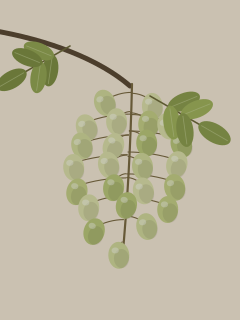
Lentisk, terebinth, Chinese pistache: these names come up constantly as soon as you start looking into pistachio trees, and they are easy to mix up. All of them belong to the same botanical genus, Pistacia. But planting a lentisk in the hope of pistachios is like planting a dog rose in the hope of florist’s roses.
What is the difference between the pistachio tree, the mastic tree and the terebinth?
| True pistachio | Terebinth | Mastic tree (lentisk) | |
|---|---|---|---|
| Latin name | Pistacia vera | Pistacia terebinthus | Pistacia lentiscus |
| Foliage | Deciduous | Deciduous | Evergreen |
| Leaf | 3 to 5 large, rounded leaflets | An odd number of leaflets, with one at the tip | Small, leathery leaflets in an even number, with none at the tip |
| Height | 6 to 10 m | Usually 5 m, sometimes more | Up to 6 m, often shrubby |
| In France | Cultivated only | Wild, in garrigue and holm oak woods | Wild, in maquis and along the coast |
| Fruit | Pistachios | Small berries, red then brown | Small berries, red then black |
| Use | The nut | Rootstock for the pistachio | Resin, hedging, ornamental |
All three have one thing in common: each tree is either male or female. In the mastic tree as in the true pistachio, only the female trees bear fruit.
The true pistachio: the only one that bears pistachios
Pistacia vera comes from Central Asia and the Near East. In France it only exists where it has been planted: in orchards in the south, in a few gardens, and as very old trees left over from the plantings of the 18th and 19th centuries, near Aubagne, in Marseille, on the Crau plain and in the Luberon.
You can recognise it by its large leaves, made up of three to five broad, thick leaflets, and, on female trees, by its clusters of fruit that turn pink at the end of summer. It loses its leaves in winter.
The terebinth: the wild cousin from Provence
The terebinth grows wild in the garrigue, the dry scrubland of Provence, and in its holm oak woods. It is a small deciduous tree that turns red in autumn. Crush a leaf and it smells of resin. This is the tree that turpentine was once made from.
One feature identifies it for certain: it often carries long galls shaped like horns or pods, red then brown, caused by aphids. Its fruits are small berries in clusters, red then brownish, the size of a peppercorn.
For the pistachio, the terebinth is valuable: pistachio trees were already being grafted onto its roots in Provence two centuries ago, and it is still the most widely used rootstock in Spain. It is more cold-hardy than the others and costs less. We compare rootstocks in our article on grafting pistachio trees.
The mastic tree: the shrub that gives mastic
The mastic tree, or lentisk, is the shrub of the maquis and the Mediterranean coast. It keeps its leaves all year round, which is enough to tell it apart from the other two in winter. Its leaves are small, leathery and a dark, glossy green. In Provence, it reaches its limit in the south of the Vaucluse, on the southern slope of the Petit Luberon.
Its treasure is not its fruit but its resin, mastic, harvested since ancient times on the Greek island of Chios and used in Middle Eastern sweets and pastries. In the garden, it makes an evergreen hedge in regions with mild winters: it is far less hardy than the true pistachio.
How do you tell a mastic tree from a terebinth?
Three tests, from the simplest to the most reliable.
- In winter, look at the tree. If it is in leaf, it is a mastic tree. If it is bare, it is a terebinth.
- In summer, count the leaflets. On the mastic tree, they come in pairs and the leaf ends without a leaflet at the tip. On the terebinth, a single leaflet ends the leaf: the number is odd.
- Look for galls. Large red or brown horns at the tips of the shoots mean a terebinth.
The two species sometimes cross. In the Calanques, the limestone inlets near Marseille, botanists have described a natural hybrid between the mastic tree and the terebinth.
What about the Chinese pistache?
Pistacia chinensis is an ornamental tree, planted for its autumn colour, from yellow to scarlet. It grows taller than the others and bears no edible pistachios. You will find it in ornamental nurseries under the name Chinese pistache.
What should you check before buying a “pistachio tree”?
- To harvest pistachios: Pistacia vera, grafted, with the variety named, as one male and one female tree. See our article on growing a pistachio tree in the garden.
- For an evergreen hedge in a mild climate: Pistacia lentiscus.
- For a tree with autumn colour: Pistacia chinensis, or the terebinth in a dry garden in the south of France.
The common name is never enough. Only the Latin name, written on the label, tells you what you are buying.
Frequently asked questions
Does the mastic tree produce pistachios?
No. The mastic tree bears small berries, red then black, which have nothing in common with pistachios. Only the true pistachio, Pistacia vera, produces them.
Is the mastic tree edible?
Its fruits are not eaten like pistachios. Oil has been pressed from them in some parts of the Mediterranean, and its resin, mastic, is a traditional food product in Greece. Never eat a wild plant unless you are certain what it is.
Can you graft a pistachio tree onto a terebinth?
Yes, it is in fact the traditional rootstock for pistachios in Provence and the most widely used one in Spain. The mastic tree, on the other hand, is not listed as a rootstock in the technical references we consulted.
Are there wild pistachio trees in France?
The terebinth and the mastic tree grow wild, but the true pistachio does not. The very old true pistachio trees in Provence are what remains of former plantings.
Is the mastic tree male or female?
One or the other, like all pistachio trees: male and female flowers grow on separate plants, and only the female plants bear berries.
Sources
- Le pistachier en Provence, étude ethnobotanique, Magali Amir, Courrier scientifique of the Luberon Regional Nature Park, no. 16, 2019–2020, in French.
- Pistachio tree: growing guide, Gerbeaud, in French.
- Pistachio tree: planting and care, Jardiner Malin, in French.
- Overview of pistachio growing: climate, soil, rootstocks, varieties, IRIAF El Chaparrillo (Castilla-La Mancha), Agricultura magazine, 2010, in Spanish.
- La operación de injerto: grafting the pistachio tree, El Chaparrillo, Fruticultura magazine, 2004, in Spanish.
- Le pistachier, Pistache en Provence association, in French.