Tasting
Pistachios: calories, portion size, health benefits, and what the evidence says
Pistachios are fatty and high in calories, and yet health authorities recommend them. That is not a contradiction. Here are the figures, the studies, and what they do not allow anyone to claim.
A word before the figures: we grow pistachios, we are not doctors. This article brings together published data, with its sources, and sticks to what that data says. It is no substitute for advice from a health professional, particularly if you have an allergy or a chronic illness.
How many calories are in pistachios?
| Raw pistachios | Per 100 g | Per 30 g |
|---|---|---|
| Energy | 560 kcal | 168 kcal |
| Protein | 20.2 g | 6.1 g |
| Fat | 45.3 g | 13.6 g |
| of which saturates | 5.9 g | 1.8 g |
| Carbohydrate, including fibre | 27.2 g | 8.2 g |
| of which fibre | 10.6 g | 3.2 g |
| Potassium | 1,020 mg | 306 mg |
| Vitamin B6 | 1.7 mg | 0.5 mg |
| Sodium | 1 mg | less than 1 mg |
So pistachios are a dense food: almost half their weight is fat. But 87% of that fat is unsaturated, and it comes with fibre and protein, which is not the case with a cocktail cracker of the same calorie value.
How many pistachios should you eat a day?
The official French benchmark is simple: a small handful of unsalted nuts a day. Santé publique France names pistachios specifically, along with walnuts, hazelnuts and almonds.
A handful is about 30 grams of kernels. For pistachios, that means:
- around fifty shelled pistachios;
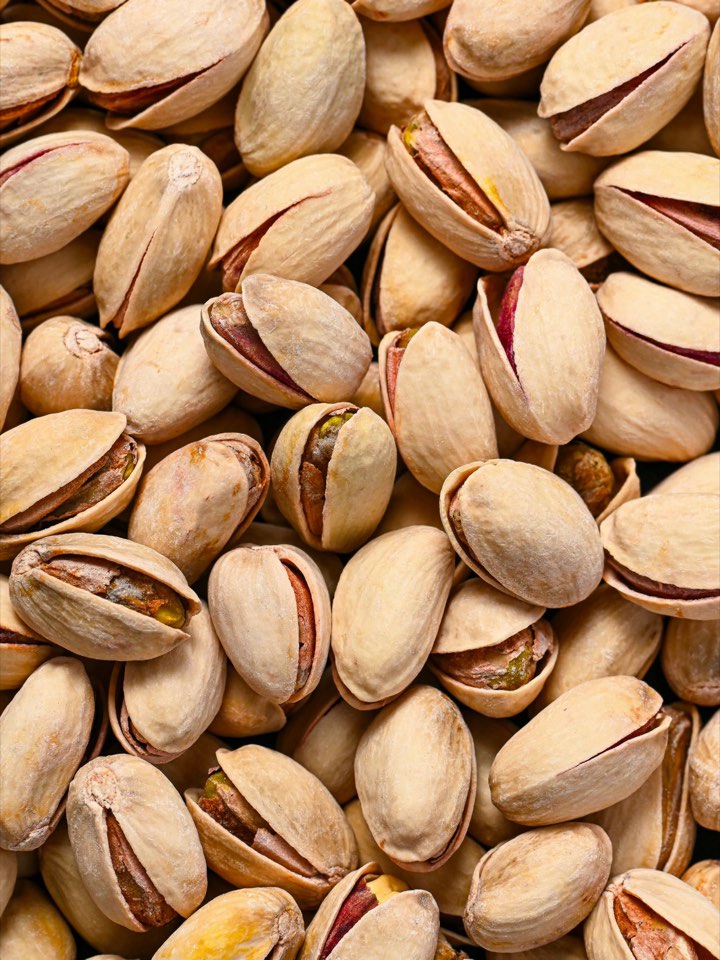
- a little under 60 grams of pistachios in the shell, since the shell accounts for nearly half the weight of the nut;
- about 170 kcal, 6 g of protein and 3 g of fibre.
It is a guideline, not a regulatory limit. It applies to pistachios that are unsalted, unsweetened and not coated in chocolate.
Do pistachios make you put on weight?
Not in clinical trials. A meta-analysis published in 2021 pooled trials in which adults added pistachios to their diet: it found no significant change in weight, body mass index or waist circumference.
That doesn’t make pistachios magic. A 250 gram bag of in-shell pistachios contains more than 700 kcal, and salted roasted pistachios are easy to eat without noticing. Portion size matters. One advantage of in-shell pistachios that is often pointed out: you have to open them, which slows you down, and the pile of empty shells shows how much you have eaten.
What are the health benefits of pistachios?
It is worth separating what pistachios contain from what has been measured in people who eat them.
What they contain
- Fibre: 10.6 g per 100 g, or 3 g per handful.
- Protein: 20 g per 100 g.
- Vitamin B6: a handful covers a little over a third of the daily reference intake.
- Potassium: 1,020 mg per 100 g of raw pistachios.
- Pigments: lutein and zeaxanthin, the yellow pigments also found in the retina, and polyphenols.
What the trials have measured
| Measure | Average effect of pistachios |
|---|---|
| Total cholesterol | −7.5 mg/dL |
| LDL cholesterol | −3.8 mg/dL |
| Triglycerides | −11.2 mg/dL |
| HDL cholesterol | unchanged |
| Fasting blood sugar | −5.3 mg/dL |
| Systolic blood pressure | −2.1 mmHg |
| Weight | unchanged |
What to make of it
These effects point in the right direction, and they are modest. A 4 mg/dL drop in LDL cholesterol is no substitute for any treatment. Some of the research on pistachios is funded by American growers, which is a reason to read the results with a degree of caution. And in Europe, no health claim specific to pistachios is authorised: among nuts, only the walnut has been granted one.
What can fairly be said is this: pistachios are a good food, with a place in a varied diet. They don’t cure anything.
Raw, roasted, salted: what difference does it make?
| Raw | Dry-roasted | |
|---|---|---|
| Energy | 560 kcal | 572 kcal |
| Water | 4.4 g | 1.9 g |
| Vitamin B6 | 1.7 mg | 1.1 mg |
| Lutein and zeaxanthin | 2,900 µg | 1,160 µg |
| Potassium | unchanged | |
Roasting removes water, which concentrates the calories slightly, and it destroys some of the heat-sensitive vitamins and pigments. In return, it brings out the aroma and the crunch. Nutritionally, the difference is small.
Salt is another matter. Salted roasted pistachios contain about 1.7 g of salt per 100 g: a handful provides 0.5 g, a tenth of the most an adult should eat in a day. That is why the official guideline specifies “unsalted”.
Who should be careful?
- People with allergies. Pistachio is one of the allergenic tree nuts. Its proteins are very close to those of cashew: when someone is allergic to one, allergists always check for an allergy to the other.
- Children under 6. No whole nuts, because of the risk of choking. Give them nuts ground or as a smooth paste.
- People watching their salt intake. They should choose unsalted pistachios.
Frequently asked questions
Is it good to eat pistachios every day?
Yes, as long as it is a small handful of unsalted pistachios: that is the guideline from Santé publique France for nuts as a whole.
How many calories are in 100 g of pistachios?
560 kcal for raw pistachios, 572 kcal for dry-roasted pistachios, and a little over 600 kcal for salted roasted pistachios. These figures are for the kernel alone, without the shell.
How many pistachios are in 30 g?
Around fifty shelled pistachios. In the shell, 30 g of kernels corresponds to a little under 60 g of pistachios.
Are pistachios good for cholesterol?
Clinical trials show an average drop of 3.8 mg/dL in LDL cholesterol in people who eat them. It is a real but modest effect, and no substitute for treatment or medical follow-up.
Are pistachios an allergen?
Yes. They are among the tree nuts that must be declared on food labels. Pistachio allergy very often goes hand in hand with cashew allergy.
Sources
- Raw pistachios: nutrient composition, USDA FoodData Central.
- Dry-roasted pistachios, without salt: nutrient composition, USDA FoodData Central.
- Ciqual French food composition table, Anses, the French food safety agency.
- Augmenter les fruits à coque non salés, Manger Bouger, Santé publique France (the French public health agency), in French.
- Regulation (EU) No 432/2012: list of permitted health claims, EUR-Lex, French-language version.
- Pistachios and blood lipids: a meta-analysis of 12 trials, Hadi et al., 2023, PubMed 34933637.
- Pistachios and blood sugar control: a meta-analysis, Hadi et al., British Journal of Nutrition, 2023, PubMed 35795961.
- Pistachios, body weight and blood pressure: a meta-analysis, Asbaghi et al., 2021, PubMed 33198823.
- Allergies aux fruits à coque, C. Quéquet, La Revue du Praticien, 23 April 2024, in French.
- Scientific review of the pistachio: production, pigments, nutrients, health, Mandalari et al., Plants journal, 2022.